
 Available Kittens
 Available Adult Bengals
Bengal Kittens for sale!
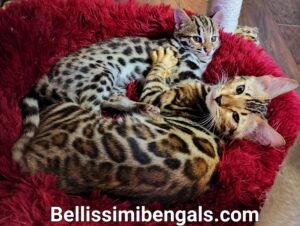
ABOUT BENGAL CATS
The Bengal cats are extremely intelligent and curious cats. You can train them to open the window, door or even cabinet, in fact they may open doors and cabinets even if you don’t train them! Bengal cats like being up high, there is no need to wonder when you find your Bengal cat climbing the highest places in the house. You will also find that they are very dog-like in personality, following you from room to room in your home and always greeting you with a loving welcome. Whether male or female, this exotic, unique cat will hold a place in your heart forever like no cat as ever done before.
The Ideal Companion
They will grace any home and be a loyal life companion. They are wonderful with children, other pets! Bengal cats can be the perfect companions for the experienced cat
owners and active families. If you have a dog at home, it is okay to have Bengal cat, your cat will not be afraid, in fact he may boss the dog around.
The Popularity
Shedding and Grooming
Is the Bengal Cat Hypoallergenic?
THEY ARE NOT HYPOALLERGENIC CATS!
People still may have reactions to them just like with any other cat. If that’s the case, Flonase is your best friend!
Bengal Cat Colors: A Guide to Their Stunning Coats
Bengal cats are known for their exotic, wild appearance and striking patterns that resemble leopards. While their signature spotted or marbled coats are widely recognized, Bengal cats come in a variety of stunning colors. These colors fall into two main categories: standard (recognized by major cat associations) and non-standard (rarer or newer variations).
Standard Bengal Cat Colors
Brown Bengal
The most common and traditional Bengal color.
Comes in shades ranging from light golden to deep mahogany.
Typically has black, dark brown, or reddish markings with a white or cream underside.
Snow Bengal
A lighter variation with three distinct subtypes:
Seal Lynx Point – The palest, with a creamy white base and subtle spots that darken as the cat matures.
Seal Mink – Slightly darker than the Lynx Point, with a beige or light tan background and well-defined markings.
Seal Sepia – The darkest snow variety, featuring a warm brown tone and bold contrast.
Silver Bengal
Has a cool-toned, silver or grayish base with black or charcoal markings.
Lacks warm, brownish hues due to the inhibitor gene, which suppresses warm colors.
Often features a striking contrast between the base coat and markings.
Rare Bengal Colors
Charcoal Bengal
Can appear in brown, silver, or snow variations.
Characterized by a darker “mask” on the face and a thick dorsal stripe running along the back.
Blue Bengal
A rare dilution of the brown Bengal.
Features a soft, grayish-blue base with dark blue or slate-colored markings.
Melanistic (Black) Bengal
Often called the “Black Panther” Bengal.
Has a nearly solid black coat, though faint ghost markings can be seen under certain lighting.
Bengal cats are admired for their unique beauty, and their color variations only add to their appeal. Whether you’re drawn to the classic golden hues or the rare silvers and blues, each Bengal cat is a living piece of art with a wild and luxurious look.
Early Generation Bengals (F1–F3)
These are called Filial Bengals, meaning they are only a few steps away from the wild Asian Leopard Cat (ALC).
F1 (First Generation):
Parent: 1 ALC + 1 domestic cat (usually Bengal).
Wild %: ~50%.
F2 (Second Generation):
Grandparent is an ALC.
Wild %: ~25%.
F3 (Third Generation):
Great-grandparent is an ALC.
Wild %: ~12.5%.
F1–F3 Bengals are restricted or banned in some areas, because they’re legally considered hybrids, not fully domestic.
Please check with your local state laws.
SBT Bengals (F4 and Beyond)
SBT = Stud Book Tradition. This means they’re at least 4+ generations removed from the ALC and are considered fully domestic cats.
F4 (Fourth Generation) and later:
Great-great-grandparent is an ALC (or further back).
Recognized by TICA, CFA, and other registries.
Our Zikki Ramsey of Bellissimi
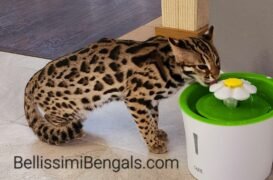
The Asian Leopard Cat (ALC) (Prionailurus bengalensis) is a small wild cat native to Asia, and it’s the foundation species of the Bengal cat breed. Its history is tied both to its natural range and to its role in domestic cat breeding. Here’s the breakdown:
Natural History
Origin & Range:
The Asian leopard cat is widespread across southern and eastern Asia, from the Russian Far East, Korea, and northern China down through India, Southeast Asia, and the Indonesian islands. Because of this wide range, it has developed many subspecies with different coat patterns and sizes.
Appearance:
They typically weigh 7–15 lbs (3–7 kg) and resemble a domestic cat in size but have a leaner, more muscular body. Their coats are marked with rosettes, spots, or stripes, varying by region.
Behavior:
ALCs are solitary, nocturnal hunters. They live in forests, grasslands, and wetlands. Their diet includes rodents, birds, reptiles, and insects. Unlike domestic cats, they are highly wary of humans and not naturally affectionate.
2. Historical Significance
Ancient Times:
Archaeological evidence suggests ALCs were kept around human settlements thousands of years ago. In China, leopard cats may have been semi-domesticated before true domestic cats (Felis catus) spread there.
Cultural Value:
In several Asian cultures, ALCs were admired for their wild beauty and sometimes kept as exotic pets. Their pelts were also historically used in trade.
3. Role in Bengal Cat Development
Breeding with Domestic Cats:
In the 1960s–1980s, breeders in the U.S. began crossing ALCs with domestic cats to create a companion animal with the exotic appearance of a wild cat but the temperament of a house cat.
The most influential program was by Jean Mill in California, who produced the first generations of what became the Bengal cat breed.
The early generations (F1–F3) were often more shy, cautious, or wild-like, but later generations (SBT Bengals) stabilized into today’s breed standard.
Conservation Tie-In:
Part of the initial motivation for Bengal breeding was to reduce the demand for wild cat fur by giving people a domestic alternative with a similar look.
4. Current Status
Conservation:
The Asian leopard cat is not endangered overall (classified as Least Concern by the IUCN), but some subspecies are threatened by habitat destruction, poaching, and the illegal pet trade.
Modern Relevance:
Today, ALCs remain in the wild throughout Asia, but they’re also still bred occasionally in captivity, primarily for the Bengal breeding program. Their role in the Bengal’s ancestry is what gives the breed its unique coat and wildcat look.
So, the ALC is essentially a wild forest hunter with ancient ties to human settlements, a history of being admired and exploited, and a modern legacy as the genetic backbone of the Bengal cat.
From Bellissimi Bengals,
Be Aware of Bengal Scammers advertising Bengal kittens!
Please do your research and Video call, make sure the kitten is actually real!

Bengal Cats impress us with their beauty and their grace. Their country of origin is USA. The Bengal cats have something mysterious and graceful just as their Asian Leopard ancestors. Once separated by four generations from the original Asian leopard Cat and domestic cat crossing, the breeds temperament resembles that of a domestic cat. They are captivating and strikingly beautiful in appearance. Bengal cats have a sleek, soft coat, which is more like a pelt rather than an ordinary cat coat.
The difference between the two is that the F1 Bengal Cat is the first generation cross between a Bengal cat and an Asian leopard cat. These cats are 50% wilder. They are also more spotted, and they look more of the Asian leopard cat, they also sound a little different and are extremely vocal with many sounds. These cats are considered more exotic, and usually higher in price.
As long as they are exposed to you on daily basis and socialized with all family members in the house, they can make loving pets! Cats usually don’t trust just anyone, they have to build this trust over time.
When you are their human, and they grow with you, they are very devoted to their humans. But there is a possibility that your F1 may bond to only to one human in the house. Or if you have another cat in the house, the F1 may only bond with that cat and not you.
We love the early generation Cats and are my favorite. These cats have huge personalities!
F1 Bengal cats can have a dog like personality. They will even Wagg their tail like a dog when they greet you, they also move about as quickly as a happy dog, if you can picture that. But all the time!
F1 Bengals are also born hissing and spitting while their eyes are still closed. Spitting sounds like little sneeze but is a spit. Lol No this does not mean they are actually spitting at you, just only with their sound. This is actually very cute and funny. After all this comes from the Asian Leopard Cat himself and is their normal behavior. It is super adorable, and we love it. They will also growl at their toys and while eating, which is also super adorable! When they grow up, they may occasionally spit and hiss at their toys or when a stranger walks into your house. F1 Kittens are born fuzzy, and their coats clear out by 4 months of age. The SBT are born clear and start their fuzzy stage at 4 weeks of age, they also clear out by 4 months of age. F1 Bengals also have spots on the back of their ears, SBT Bengals do not. We also love the extra spotted coats and their white spotted bellies, which you do not see much in the later generation cats.
The structure of the F1 Bengal is also a little different and resembles more of the Asian leopard cat. They have smaller spotted rounded ears; their faces are like of a little leopard. Their back hind legs are longer than the front legs. Their tails are thick, their heads are smaller, and they are all around all legs, and more slender.
F1, F2, F3 Bengal Males are Sterile, so only the F1 females can continue to produce the next generation F2 Bengals and so forth.
F1 Bengal Cats are very Smart! Did I say they are highly intelligent? Seems like they understand my every word! I say! They will also guard you like a watch dog at night at the end of your bed! lol We have learned that the F1 Bengals get more bonded and devoted to their humans, and more so than the later generation SBT/G5.
Diet: many people say that F1’s only eats raw food, and many people also say that F1 will never use the litter box! Let’s review!
These misconceptions are simply not true. Yes, Raw is best, and if you want to feed raw, go for it! But our F1 cats eat canned food and dry food, so yes, it’s possible to feed the can or dry.
Litter Box: Our F1 kittens have no issue using their wood pellet litter box, at this time. However, keep in mind, since the Asian leopard cat likes to (ONLY) defecate in water, sometimes you may find that on occasion your F1 Bengal may use her water bowl. If this Behavior starts up, you can simply set up a water litter box, and have both options available. However If they continue to use their normal litter with no issue, then skip the water litter box. Reach out to us if you need advice how to set one up!
F1 Bengal cats prefer a cleaner environment, they do not like to dig in litter, if another cat used it. I have actually found them to be cleaner than the SBTs. This is also why they like water sources, because they feel it’s cleaner when playing in dirty sand.
Advice: Scoop their litter daily! If you have multiple cats set up multiple litter boxes.
Another Fact: Fixing your kittens before they reach sexual maturity around 5 to 6 months of age will also prevent sparing and marking behavior, and this goes for All Bengals, both male and female.
F1 Bengals are truly amazing cats and my personal favorite, they have the true Wild look of the Asian Leopard Cat, similar sound of the Asian leopard Cat, but with a stronger bond to their human!
Our Zikki Ramsey of Bellissimi
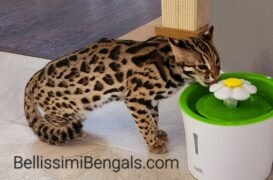
Please Be aware of Bengal Scammers advertising cheap Bengal kittens! Often, they will steal breeder’s photos and create fake information of non-existing cats! Our advice! Do your research! Video call and make sure the kitten is actually real! We have heard way too many horror stories! If the price of the kitten is too good to be true, 300 or 700
It’s usually a Scam!